Epithalon (Epitalon)
Well StudiedTetrapeptide
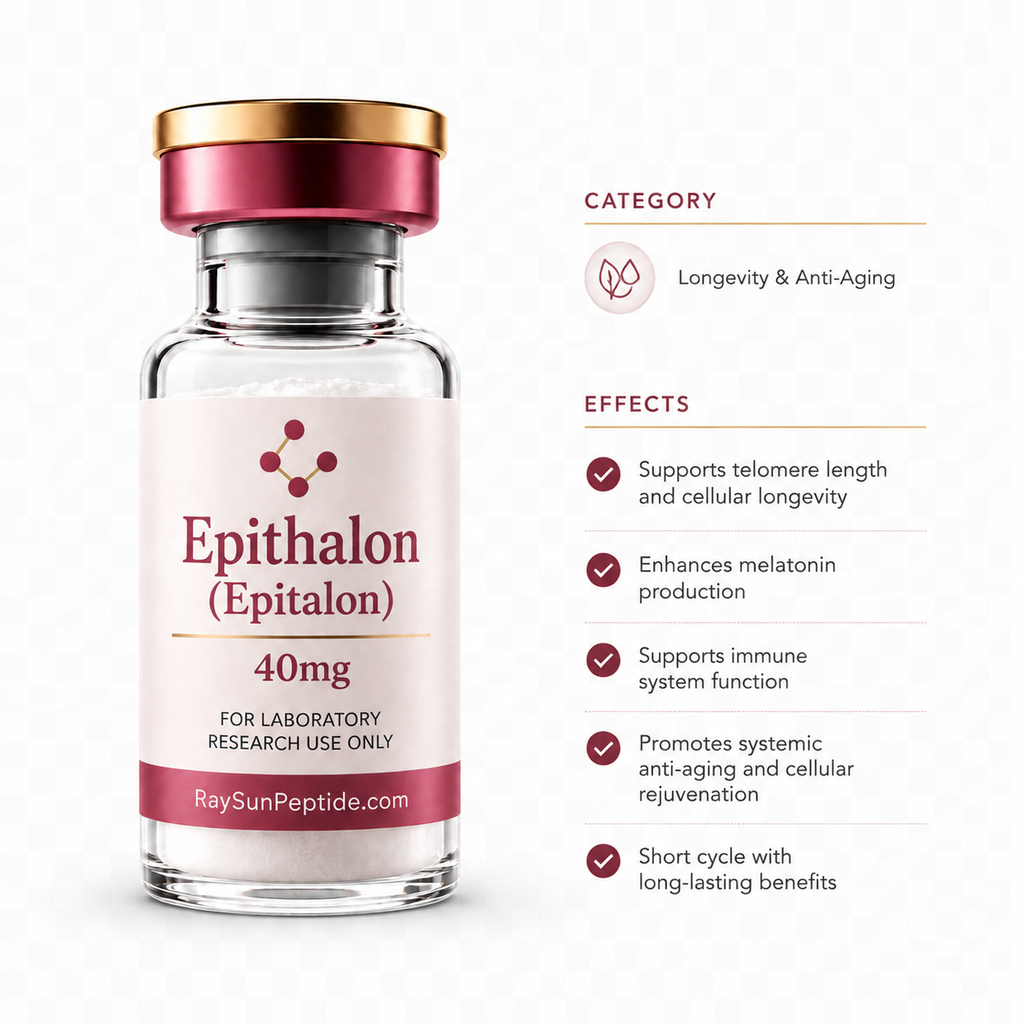
Epithalon (Epitalon) is a synthetic tetrapeptide bioregulator. It has been studied in aging research for its potential effects on telomerase activity and telomere length in cell culture models. Published research has investigated its interactions with telomerase reverse transcriptase and its effects on cellular senescence markers. RaysunPeptide supplies Epithalon for qualified research and laboratory applications.
Mechanism of Action
Activates telomerase at extremely low concentrations (10⁻¹⁷ to 10⁻¹⁵ M) to maintain telomere length, stimulates melatonin production from the pineal gland, and modulates gene expression through epigenetic mechanisms.
Key Benefits
Molecular Data
Dosing Protocols
| Goal | Dose | Frequency | Route |
|---|---|---|---|
| Standard anti-aging | 200-500mcg | 1x daily for 10-20 days | SubQ |
| Conservative start | 100mcg | 1x daily for 10-20 days | SubQ |
| Russian clinical equivalent | 300mcg | 1x daily for 10-20 days | SubQ |
| Ultra-low dose | 50mcg | 1x daily for 10-20 days | SubQ |
Research Indications
Anti-Aging
Activates telomerase at microgram doses to extend telomeres and cellular replicative lifespan.
Reverses aging markers and improves mitochondrial function at the cellular level.
Animal studies show 25-33% lifespan increases using 30-40mcg/kg doses.
Neuroprotection
Restores pineal gland function and circadian melatonin rhythm in elderly.
Supports new neuron formation at nanogram concentrations.
90% response rate for retinal degeneration at 5mcg per eye dosing.
Immunity
Supports thymus gland regeneration for improved immune function.
Enhanced immune surveillance and countering of immunosenescence.
Peptide Interactions
Both work through pineal pathways; may enhance circadian rhythm effects.
Enhanced immunomodulation - commonly combined in Russian protocols.
Different anti-aging pathways; complementary mechanisms.
Different axis activation; no known interactions.
Different regenerative mechanisms.
Both are neuroprotective; monitor for cumulative effects.
Different neurocognitive focus.
Telomerase activation may theoretically affect malignancy; avoid with active cancer.
What to Expect
Side Effects & Safety
Common (Generally Mild)
- •Generally well-tolerated with minimal side effects
- •Mild injection site reactions
- •Vivid dreams (melatonin-related)
- •Possible mild digestive upset (oral route)
Stop Signs (Seek Medical Attention)
- ⚠Signs of allergic reaction
- ⚠Persistent injection site inflammation
- ⚠New or changing moles (monitor skin)
- ⚠Cancer diagnosis (discontinue immediately)
- ⚠Unusual fatigue or weakness
Contraindications
- ✕Active malignancy (telomerase activation concern)
- ✕Chronic sinusitis (nasal route)
- ✕Known peptide allergies
- ✕Pregnancy or breastfeeding
Quality Checklist
Good Signs ✓
- White to off-white lyophilized powder
- Clear, colorless solution when reconstituted
- Certificate of analysis available (>98% purity)
- Medical-grade pharmaceutical appearance
- Proper cold-chain shipping
Warning Signs !
- Widespread dosing misinformation exists
- Many sources recommend 5-10mg based on translation errors
- Original research demonstrates microgram efficacy
- Verify supplier credentials carefully
Bad Signs ✕
- Yellow or discolored powder (degradation)
- Cloudy solution after mixing (contamination)
- Missing or questionable sourcing documentation
References
Addition of epithalon to telomerase-negative human fetal fibroblast culture induced expression of catalytic subunit (hTERT), enzymatic activity of telomerase, and telomere elongation. Extended replicative lifespan of cells.
View on PubMed →Clinical trial of 266 elderly subjects over 6-8 years: Epithalamin reduced mortality 1.6-1.8 fold. Combined Thymalin + Epithalamin treatment for 6 years reduced mortality 4.1-fold vs control with improved cardiovascular and immune parameters.
View on PubMed →Epitalon significantly stimulated melatonin synthesis in senescent monkeys during evening hours, normalizing circadian rhythm of cortisol secretion and restoring neuroendocrine regulation.
View on PubMed →Epitalon therapy in patients with degenerative retinal lesions resulted in positive clinical effect in 90% of cases, intensifying bioelectric and functional activity of retina due to preservation of morphological structure.
View on PubMed →Epitalon injected from 3 months until natural death increased maximum lifespan by 12.3% and last 10% survivors by 13.3%. Slowed age-related estrous function decline and reduced chromosome aberrations by 17.1%. Inhibited leukemia development 6-fold.
View on PubMed →AEDG peptide increased neurogenic differentiation markers (Nestin, GAP43, β-Tubulin III, Doublecortin) 1.6-1.8 fold in human gingival mesenchymal stem cells. Molecular modelling showed preferential binding with H1/6 and H1/3 histones, suggesting epigenetic regulation.
View on PubMed →FAQs
What's the correct Epitalon dosage—why do some sources recommend 5-10mg versus 0.5-1mg?
Peer-reviewed human clinical trials show efficacy at 0.5-1mg daily, while many community protocols recommend 5-10mg based on what appears to be translation errors from animal studies. Original research demonstrates microgram-level activation of telomerase, making lower doses research-supported. Higher doses lack human validation and are significantly more expensive.
Does Epitalon really extend lifespan or is that just animal studies?
Animal studies show 25-33% lifespan extension with Epitalon, and a 6-8 year clinical trial of 266 elderly subjects found a 1.6-1.8 fold mortality reduction with Epithalamin. While impressive, human lifespan extension claims remain theoretical. Effects on cellular aging markers like telomere length are better documented than actual longevity in humans.
Should I worry about Epitalon and cancer risk given telomerase activation?
Telomerase activation theoretically carries cancer risk, which is why Epitalon is contraindicated in active malignancy. However, 35+ years of research shows no increased cancer incidence in clinical trials. The key distinction: Epitalon activates telomerase in normal cells while cancer cells already have telomerase; the mechanism appears selective for aging cells.
How long after an Epitalon cycle do benefits persist?
Effects persist for months after a 10-20 day cycle due to epigenetic changes in gene expression and sustained telomerase activity. Many users repeat cycles 2-3 times yearly with 4-6 month breaks, allowing the body to maintain benefits from each cycle while avoiding continuous stimulation.