Teriparatide (PTH 1-34)
Extensively StudiedRecombinant PTH fragment
Teriparatide is a recombinant form of parathyroid hormone (PTH 1-34) that has been studied in bone metabolism research for its effects on osteoblast activity and bone formation. Published research has investigated its mechanisms of action through PTH1R signaling and its effects on calcium homeostasis. RaysunPeptide supplies Teriparatide for qualified research and laboratory applications.
Mechanism of Action
Teriparatide binds to PTH type 1 receptors (G-protein coupled receptors) on osteoblasts, osteocytes, and renal tubular cells. This activates PKA and PKC signaling pathways that promote osteoblast activity. The intermittent daily dosing creates an 'anabolic window' where bone formation exceeds resorption. Teriparatide upregulates IGF-1 and FGF2 expression, stimulates bone formation on trabecular and cortical surfaces, and increases bone mineral density through preferential osteoblast stimulation.
Key Benefits
Molecular Data
Dosing Protocols
| Goal | Dose | Frequency | Route |
|---|---|---|---|
| Osteoporosis treatment | 20 mcg | Once daily | SubQ (thigh or abdomen) |
Research Indications
Osteoporosis (FDA-Approved)
FDA-approved for women with osteoporosis at high risk of fracture.
FDA-approved for men with primary or hypogonadal osteoporosis at high risk.
FDA-approved for men and women with osteoporosis from sustained corticosteroid use.
Bone Health Research
Research interest in accelerating fracture healing and bone repair.
Investigated for jawbone regeneration in dental applications.
Peptide Interactions
Antiresorptive agents often needed after teriparatide to maintain bone gains. Can be used sequentially.
Adequate calcium and vitamin D intake recommended during teriparatide therapy.
Different mechanisms; no known interactions.
Different mechanisms; no known interactions.
What to Expect
Side Effects & Safety
Common (Generally Mild)
- •Injection site reactions
- •Nausea
- •Headache
- •Leg cramps
- •Dizziness
- •Joint pain
Stop Signs (Seek Medical Attention)
- ⚠Signs of hypercalcemia (confusion, fatigue, nausea)
- ⚠Persistent bone pain
- ⚠Allergic reactions
Contraindications
- ✕Paget's disease of bone
- ✕Prior skeletal radiation therapy
- ✕History of skeletal malignancies
- ✕Metabolic bone diseases other than osteoporosis
- ✕Pre-existing hypercalcemia
- ✕Pregnancy
Quality Checklist
Good Signs ✓
- Clear, colorless solution
- Pharmaceutical grade (Forteo)
- Proper cold chain maintained
- Intact pen device
Warning Signs !
- Research-grade products lack FDA oversight
- Temperature excursions may affect potency
Bad Signs ✕
- Cloudy or discolored solution
- Particulates visible
- Exposed to freezing or high temperatures
References
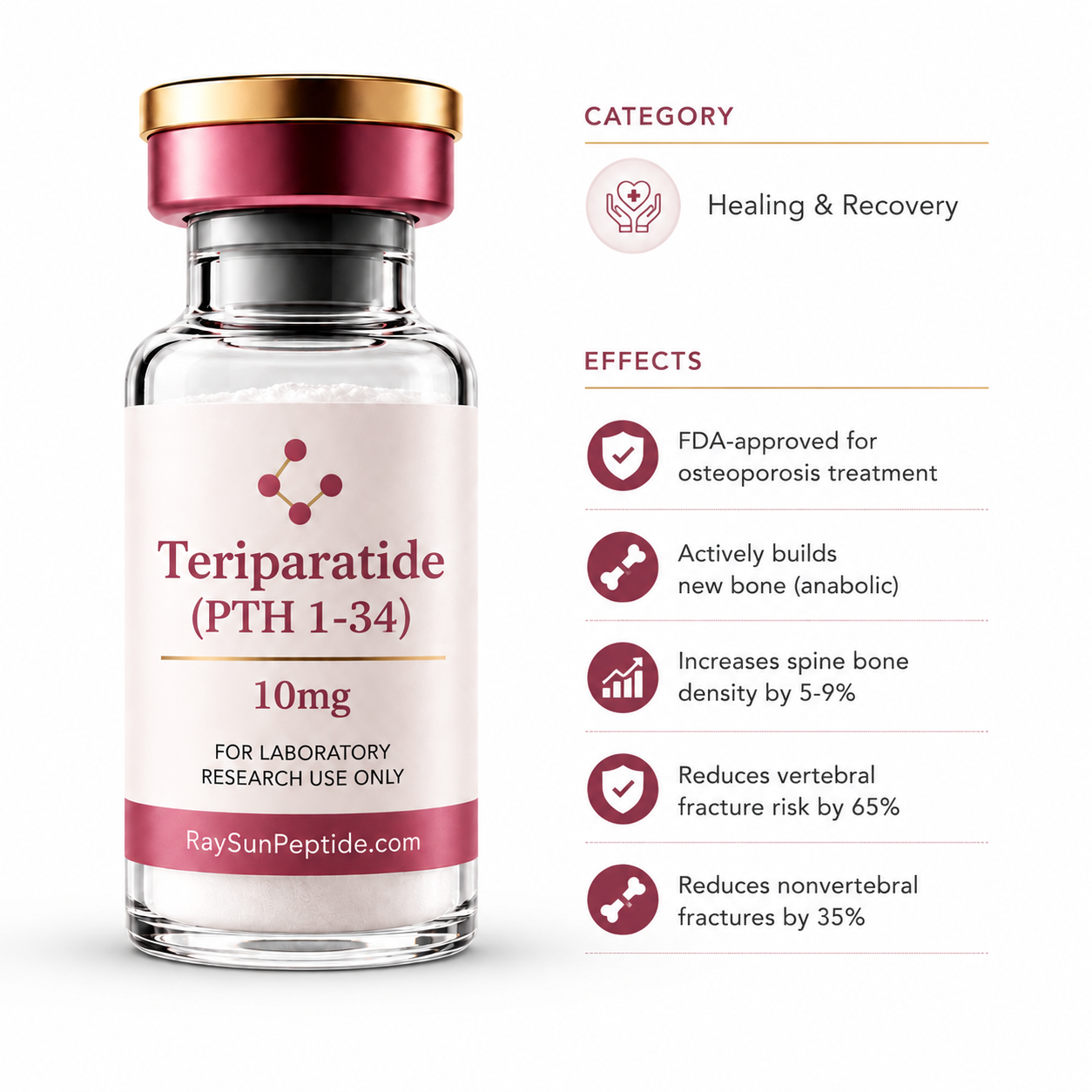
Intermittent PTH exposure induces bone formation more than resorption; FDA-approved for osteoporosis.
Spine BMD increased 5.9% (20mcg) and 9.0% (40mcg); femoral neck increased 1.5-2.9%.
Reduced vertebral fractures by 65% and nonvertebral fractures by 35% after 20 months.
Initial formation without resorption creates 'anabolic window' for rapid bone volume increase.
FAQs
Why is teriparatide limited to 2 years when it builds bone so effectively?
Teriparatide is limited to 2 years due to a theoretical osteosarcoma risk observed in rat studies at very high doses over extended periods. Human clinical trials haven't shown this risk, but the FDA maintains the 2-year lifetime limit as a precautionary measure. After 2 years, antiresorptive therapy maintains the bone gains.
Can teriparatide reverse osteoporosis or just slow bone loss?
Teriparatide actively reverses osteoporosis by building new bone, unlike antiresorptive drugs that only slow loss. Clinical trials show 5-9% spine bone density increases and 65% fracture risk reduction - making it uniquely anabolic rather than protective.
Should teriparatide be taken with calcium and vitamin D?
Yes, adequate calcium and vitamin D intake are essential during teriparatide therapy. The peptide stimulates bone formation, which requires sufficient mineral substrate. Deficient calcium/vitamin D can blunt teriparatide's effects and potentially impair bone quality despite density gains.
How does teriparatide create an 'anabolic window' for bone formation?
Daily intermittent PTH exposure stimulates osteoblasts (bone-forming cells) more strongly than osteoclasts (bone-removing cells), creating a window where formation exceeds resorption. This contrasts with continuous PTH, which causes net bone loss. The daily injection timing is critical to maintain this anabolic advantage.