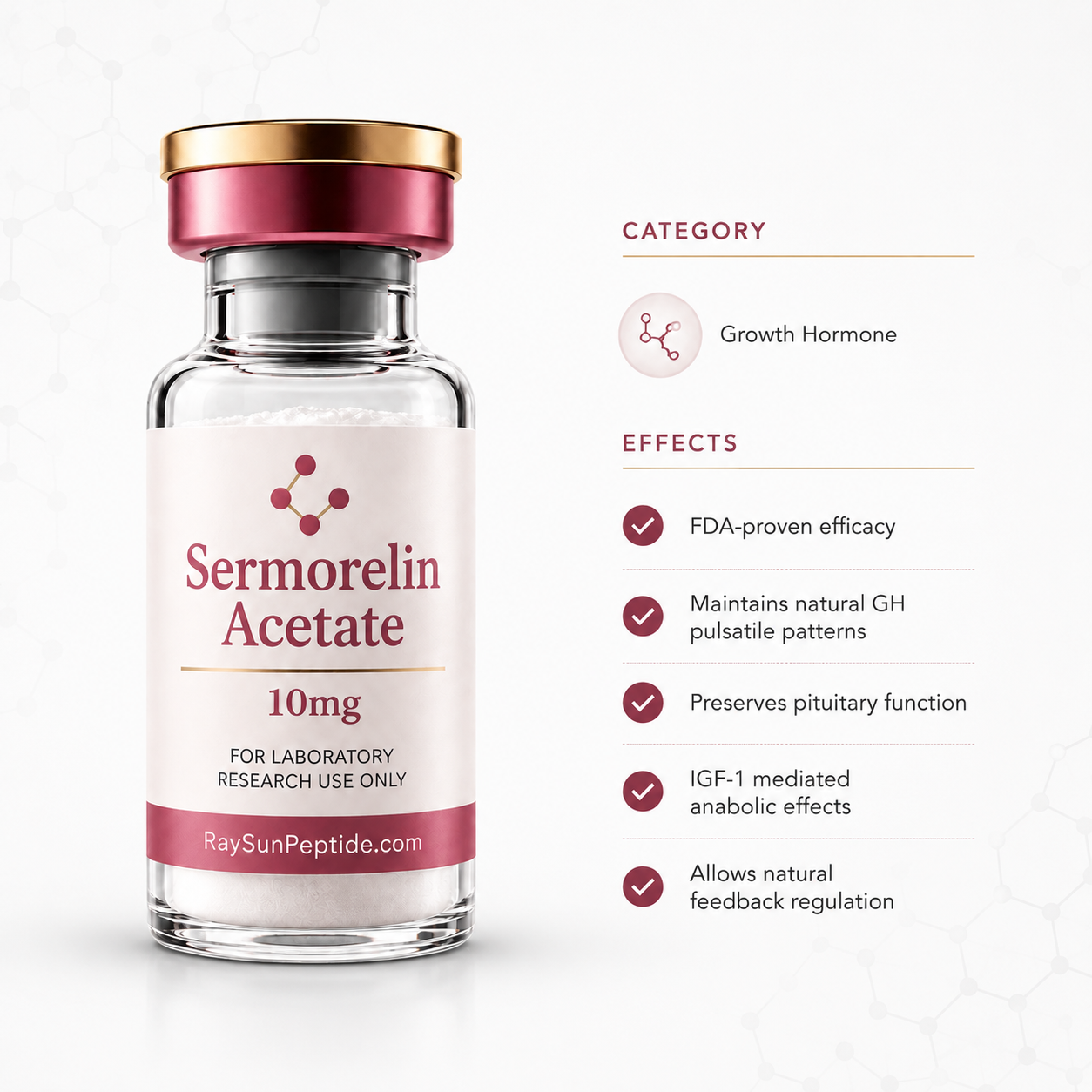
Sermorelin Acetate
Well StudiedGHRH analog
Sermorelin is a synthetic analog of growth hormone-releasing hormone (GHRH) consisting of the first 29 amino acids of native GHRH. It has been studied in endocrinology research for its effects on growth hormone secretion through pituitary GHRH receptor activation. Published research has examined its pharmacological profile and effects on the hypothalamic-pituitary axis. RaysunPeptide supplies Sermorelin Acetate for qualified research and laboratory applications.
Mechanism of Action
Subcutaneous injection provides optimal bioavailability for binding GHRH receptors, stimulating pulsatile GH release while maintaining hypothalamic-pituitary axis integrity and allowing natural somatostatin negative feedback.
Key Benefits
Molecular Data
Dosing Protocols
| Goal | Dose | Frequency | Route |
|---|---|---|---|
| Anti-aging/Longevity | 200-300mcg | Once at bedtime | SubQ |
| Athletic Performance | 300-500mcg | Once at bedtime | SubQ |
| Body Composition | 200mcg | 5 days weekly | SubQ |
| Combination Therapy | 200mcg + GHRP | Once daily | SubQ co-injection |
Research Indications
Muscle Growth
1.26kg lean mass increase documented in elderly men with improved muscle strength tests.
Endogenous IGF-1 stimulation drives protein synthesis and muscle growth.
Enhanced recovery through physiological GH stimulation.
Anti-Aging
Doubles 12-hour GH release in elderly subjects over 6 weeks.
Decreased adiposity and improved lean mass distribution.
Improved skin thickness and quality.
Hormonal
Preserves natural axis function without suppression.
Maintains physiological GH release patterns.
Peptide Interactions
Excellent combination producing 3-5 fold increases in GH release.
Highly effective combination - CJC-1295 provides sustained 6-8 day release while sermorelin offers immediate pulsatile effects.
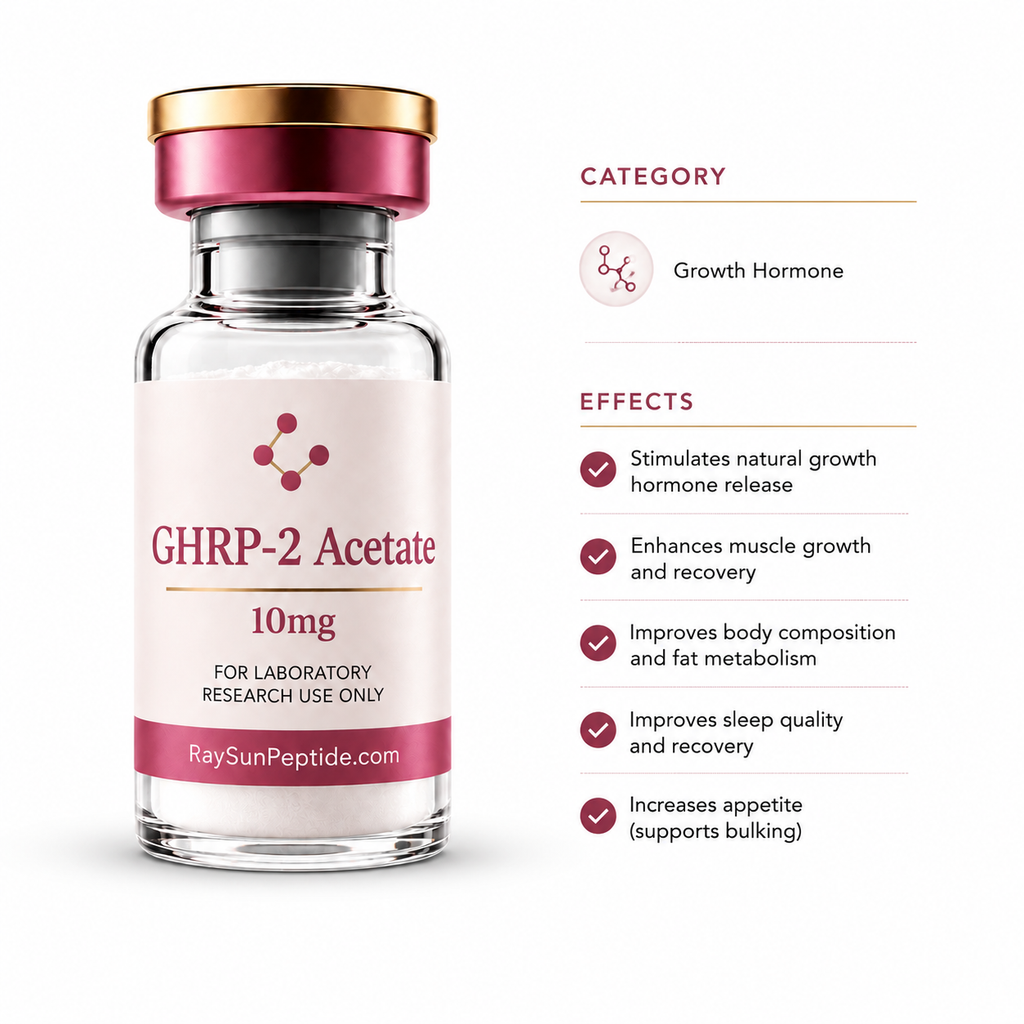
Combined GHRH+GHRP-2 produces 54-fold GH increases compared to 20-fold with GHRH alone.
Somatostatin analogs directly block GH release by activating inhibitory receptors.
High-dose glucocorticoids suppress pituitary GH release and reduce GHRH receptor sensitivity.
GH antagonizes insulin action; monitor combination closely.
Essential combination as untreated hypothyroidism prevents sermorelin response.
What to Expect
Side Effects & Safety
Common (Generally Mild)
- •Injection site reactions (16.7% of patients - generally mild)
- •Nasal irritation (intranasal route)
Stop Signs (Seek Medical Attention)
- ⚠Signs of pituitary tumor growth (headaches, vision changes)
- ⚠Severe injection site reactions or generalized allergic responses
- ⚠Uncontrolled diabetes or significant glucose intolerance
- ⚠New onset or worsening malignancy symptoms
Contraindications
- ✕Active malignancy
- ✕Pituitary tumors
- ✕Pregnancy
Quality Checklist
Good Signs ✓
- Completely clear and colorless solution without particles, cloudiness, or precipitation
- Greater than 98% peptide purity per USP standards
- Sterile, nonpyrogenic lyophilized powder
- Maintained at 2-8°C throughout transport
- Produced in FDA-registered facilities following cGMP
Warning Signs !
- Brief room temperature exposure acceptable up to 72 hours but should be refrigerated promptly
Bad Signs ✕
- Any cloudiness, particles, color changes, or precipitation indicates degradation
- Molecular weight should be exactly 3,358 daltons (free base) or 3,418 daltons (acetate salt)
References
Intranasal GRF 1-29 at 100mcg/kg induced prompt GH release in prepubertal children with peak values at 15 minutes. Demonstrated feasibility of nasal delivery with minimal side effects.
View on PubMed →Landmark study in healthy old men (68 +/- 6.2 yr). High-dose GHRH(1-29) twice daily for 14 days reversed age-related decreases in GH and IGF-I to levels not significantly different from young men.
View on PubMed →Pivotal multicenter trial with 110 prepubertal GH-deficient children. Sermorelin 30mcg/kg/day at bedtime increased height velocity from 4.1 to 8.0 cm/year at 6 months, with 74% achieving good response.
View on PubMed →5-month single-blind RCT in 19 adults (55-71 yr). Nightly GHRH analog for 4 months activated somatotropic axis. Men showed increased lean body mass, insulin sensitivity, and well-being. Skin thickness improved in both genders.
View on PubMed →Review arguing sermorelin preserves pituitary function and physiological GH pulsatility, offering a safer alternative to exogenous GH for adult-onset GH insufficiency.
View on PubMed →FAQs
Why was sermorelin discontinued if it was FDA-approved and safe?
Sermorelin was discontinued in 2008 for manufacturing reasons, not safety concerns. It was approved in 1997 and had a solid safety record, but the manufacturer stopped production. This left a gap in the market—sermorelin is now available through research/compounded sources but not as a branded pharmaceutical.
How does sermorelin preserve natural GH patterns better than taking GH directly?
Sermorelin stimulates your pituitary to release GH in its natural pulsatile pattern (high at night, low during day). Direct GH injection creates constant levels, suppressing your natural axis. Sermorelin preserves the hypothalamic-pituitary-axis (HPA) feedback loop, meaning you maintain natural regulation rather than becoming dependent on external hormones.
Why shouldn't I eat food 2+ hours before sermorelin injection?
Carbohydrates and high blood sugar suppress GH release. Eating before injection blunts your GH response by 50-80%, making the injection ineffective. Bedtime administration on an empty stomach ensures maximum GH secretion from the natural nocturnal pulse your body is primed to produce.
Can I combine sermorelin with GHRP-2 for even bigger GH increases?
Yes, and it's highly effective. GHRH + GHRP-2 combination produces 54-fold GH increases vs 20-fold with GHRH alone. However, start cautiously and monitor for joint pain/water retention. The synergy is excellent for body composition but requires more careful dose management than either alone.