Cartalax
EmergingTripeptide
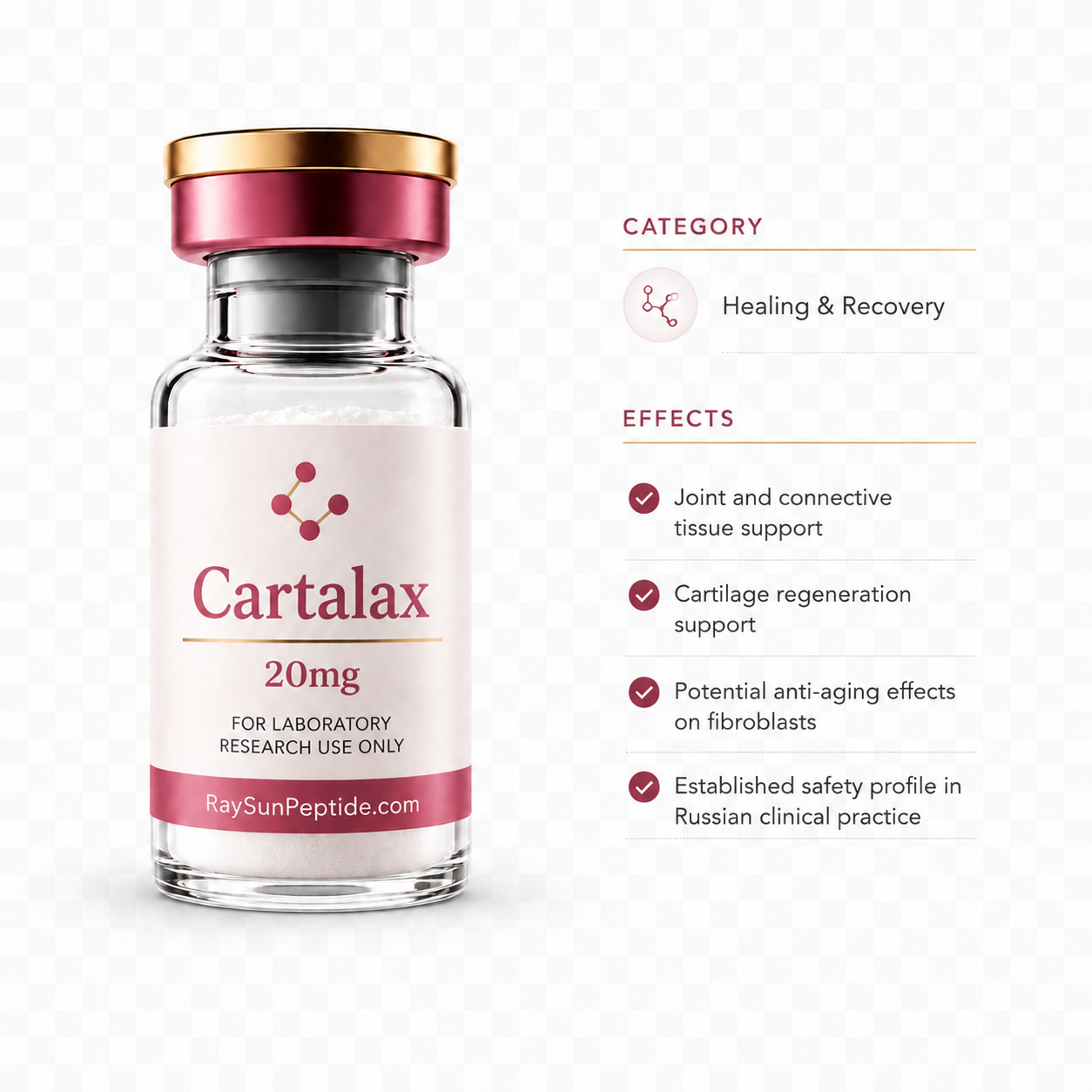
Cartalax is a peptide bioregulator that has been studied in cartilage research for its effects on cartilage tissue gene expression and chondrocyte function. Published research has investigated its role in cartilage tissue regulation. RaysunPeptide supplies Cartalax for qualified research and laboratory applications.
Mechanism of Action
Modulates cell proliferation, suppresses apoptosis, affects fibroblast activity, reduces senescence markers, and influences extracellular matrix preservation.
Key Benefits
Molecular Data
Dosing Protocols
| Goal | Dose | Frequency | Route |
|---|---|---|---|
| Joint Support | 100-200mcg (1-2 capsules) | 1-2x daily with meals | Oral |
Research Indications
Joint Health
Clinical efficacy shown in osteochondrosis, osteoarthritis, and osteoporosis treatment.
Supports cartilage maintenance and joint function.
Supports bone and connective tissue healing.
Skin Health
Increased Ki-67 expression with suppressed apoptosis in young and aged cells.
Enhances collagen synthesis in connective tissue.
Inhibited MMP-9 synthesis; maintained extracellular matrix integrity.
Peptide Interactions
Complementary bioregulatory effects across organ systems.
May enhance synthesis while supplements provide raw materials.
Different mechanisms; no direct interaction.
Distinct action pathways; may complement effects.
Both affect tissue growth; monitor for excessive proliferation.
Complementary joint support mechanisms.
What to Expect
Side Effects & Safety
Common (Generally Mild)
- •No reported side effects in Russian clinical use when taken properly
- •Well-tolerated in elderly patients
Stop Signs (Seek Medical Attention)
- ⚠Allergic reactions
- ⚠Digestive upset (rare with proper administration)
- ⚠No improvement after 3 months
- ⚠Unexpected symptoms
Contraindications
- ✕Pregnancy and breastfeeding
- ✕Active cancer (theoretical proliferation risk)
Quality Checklist
Good Signs ✓
- Professional Russian packaging with holographic seals
- Exactly 0.1mg (100mcg) AC-4 peptide complex per capsule
- Clear Russian/English instructions specifying 'with meals'
Warning Signs !
- Proper documentation required for authenticity
- Import verification needed
Bad Signs ✕
- Missing holographic seals or professional packaging
- Unclear dosing instructions
References
Human skin fibroblasts; 72 hours at 20 nM. Increased Ki-67 expression with suppressed apoptosis in young and aged cells.
Renal epithelial cells; 7 days. Reduced pro-apoptotic p53 expression in aging kidney cells.
Human subjects; 1-3 months with 0.1mg capsules daily. Efficacy in osteochondrosis, osteoarthritis, and osteoporosis treatment.
Fibroblast cultures; 5 days at 20 nM. Inhibited MMP-9 synthesis; maintained extracellular matrix integrity.
FAQs
How does Cartalax help cartilage if cartilage doesn't have blood vessels to deliver it?
Cartalax works through systemic effects on fibroblasts and gene expression. Once in circulation, it reaches fibroblasts throughout connective tissue, stimulating collagen production and suppressing matrix-degrading enzymes like MMP-9. This systemic fibroblast activation supports cartilage maintenance and collagen preservation even in avascular cartilage.
Can Cartalax reverse osteoarthritis or just prevent progression?
Russian clinical studies show efficacy in established osteoarthritis, osteochondrosis, and osteoporosis treatment. However, 'reverse' is overstated—Cartalax supports tissue repair and slows degeneration better than it rebuilds severely damaged cartilage. Results are best when cartilage damage is moderate, not advanced.
How long before joint pain improves on Cartalax?
Week 1-2 establishes baseline; minimal noticeable changes. Week 3-4 brings gradual improvement in joint comfort. Month 2 shows noticeable mobility improvements. Month 3 achieves maximum therapeutic effect. Results are cumulative with repeat cycles; 1-3 month cycles repeated annually produce best long-term joint health.
Is Cartalax safe for long-term use or does it carry cancer risk from cell proliferation?
Cartalax increases fibroblast proliferation while suppressing apoptosis. Theoretical concern exists regarding uncontrolled cell growth, but Russian clinical practice spanning decades shows no documented malignancy risk. Avoid use in active cancer; for healthy individuals, cyclic use (1-3 months on, breaks between) minimizes theoretical proliferation risk.