Semax
Well StudiedACTH(4-10) synthetic analog
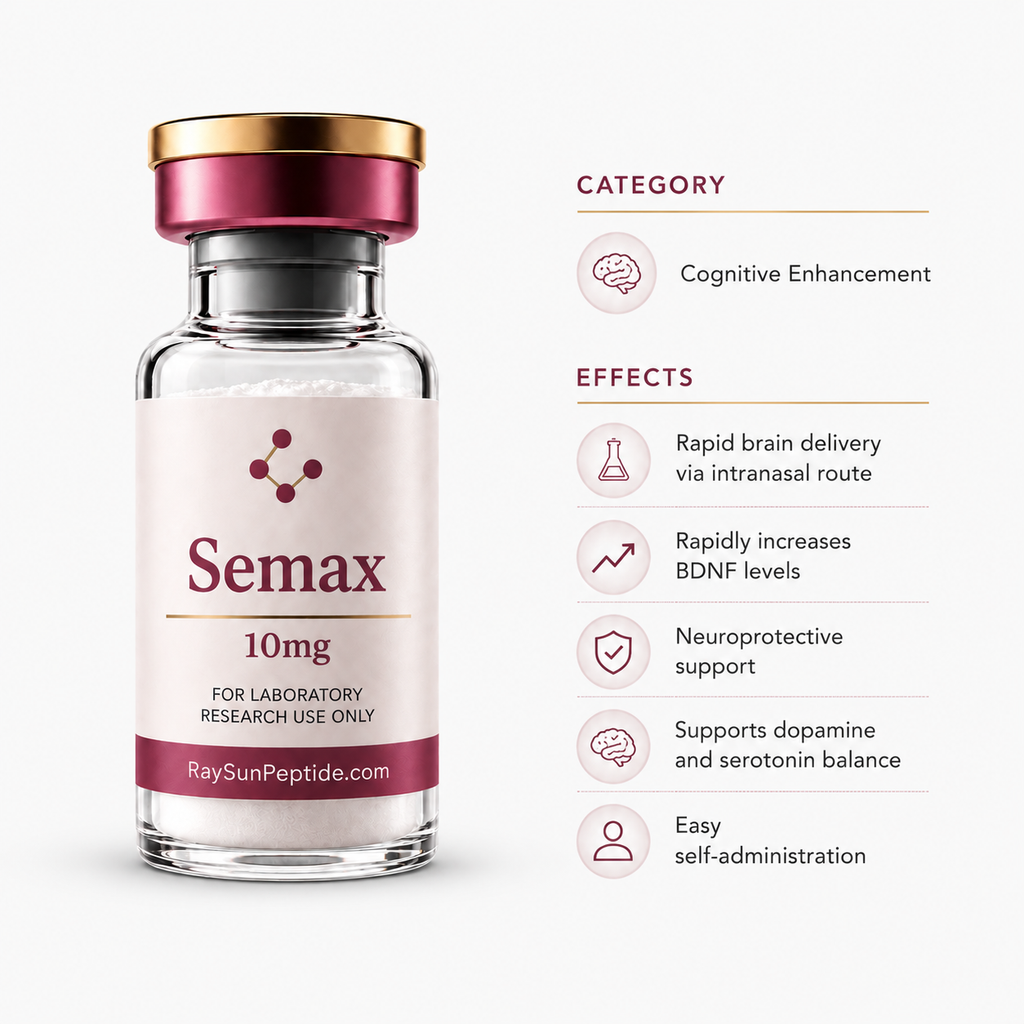
Semax is a synthetic analog of adrenocorticotropic hormone (ACTH) fragment 4-10. It has been studied in neuroscience research for its effects on brain-derived neurotrophic factor (BDNF) expression and its potential neuroprotective properties. Published research has investigated its effects on cognitive function and neuronal survival in laboratory models. RaysunPeptide supplies Semax for qualified research and laboratory applications.
Mechanism of Action
Rapidly increases BDNF levels, modulates dopaminergic and serotonergic systems, and achieves direct brain delivery through olfactory transport with 0.093% blood-brain barrier penetration (vs 0.01% IV).
Key Benefits
Molecular Data
Dosing Protocols
| Goal | Dose | Frequency | Route |
|---|---|---|---|
| Cognitive enhancement | 300-600mcg | 1-2x daily | Intranasal spray/drops |
| Intensive cognitive support | 600-900mcg | 2-3x daily | Intranasal |
| Brain injury recovery | 900-1500mcg | 2-3x daily | Intranasal |
Research Indications
Cognitive
Improved short-term and working memory performance in fatigued individuals (71% vs 41% accuracy).
Enhanced sustained attention during demanding cognitive tasks.
Faster acquisition of new information and improved retention.
Neuroprotection
Accelerated rehabilitation with increased BDNF levels in stroke patients.
Supports recovery from traumatic brain injury.
Shows anti-amyloid properties in Alzheimer's models.
Neuroplasticity
Supports neurogenesis through increased brain-derived neurotrophic factor.
Enhanced neural connections and brain network activity.
Improved ability to cope with cognitive stress.
Peptide Interactions
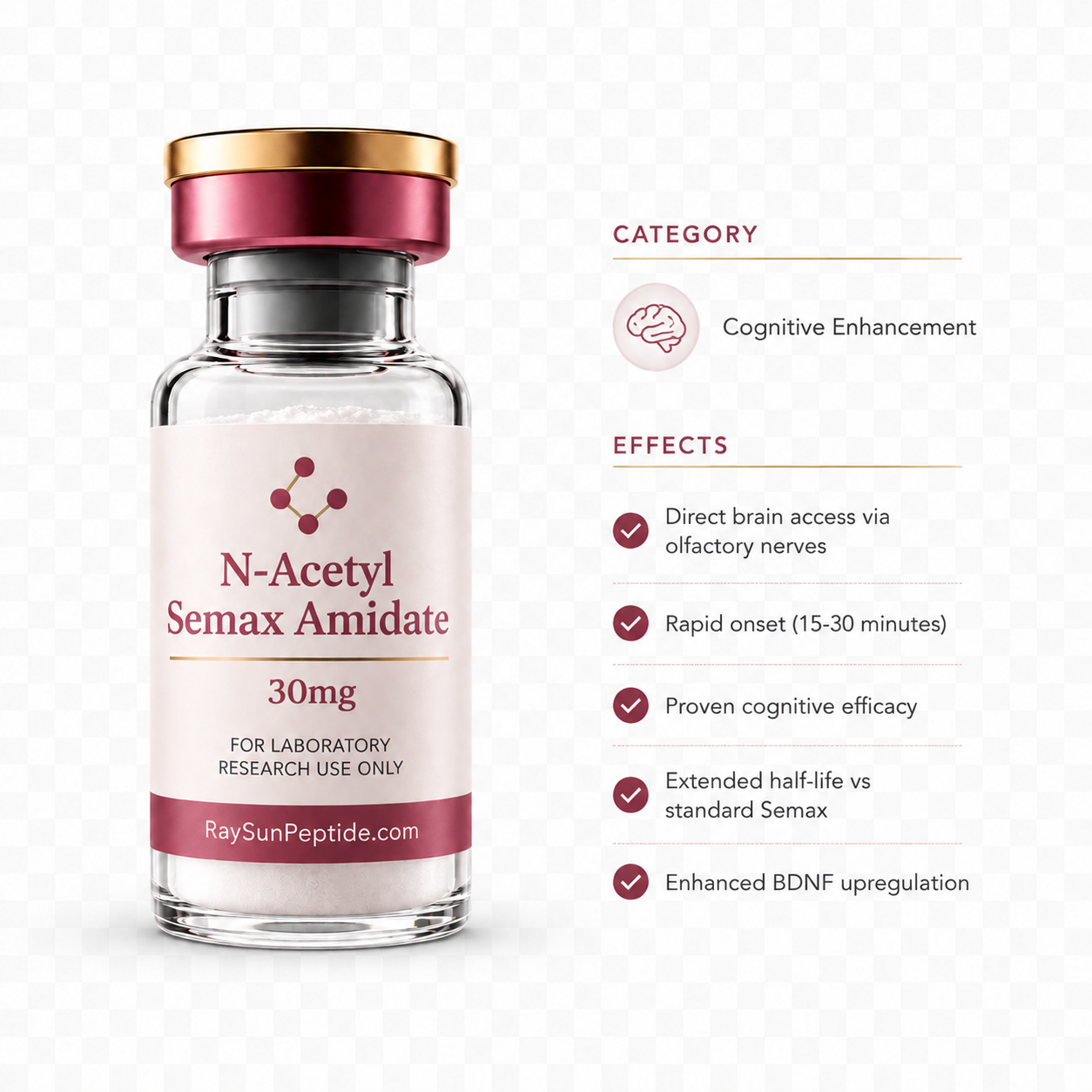
Do NOT use simultaneously. Choose one or the other - they are variants of the same peptide.
Complementary anxiolytic effects; popular combination.
Both support neuroplasticity through different mechanisms.
Comprehensive neuroprotection when combined.
May enhance stimulant effects - monitor carefully and reduce stimulant doses.
Theoretical monoamine system risk; use caution.
What to Expect
Side Effects & Safety
Common (Generally Mild)
- •Mild nasal discomfort (nasal route)
- •Possible nasal sensation upon administration
Stop Signs (Seek Medical Attention)
- ⚠Severe nasal irritation, bleeding, or persistent congestion
- ⚠Unusual anxiety, agitation, or sleep disturbances
- ⚠Headaches worsening with use
- ⚠Signs of allergic reaction (rash, breathing difficulty)
- ⚠Significant blood pressure changes or heart palpitations
Contraindications
- ✕Pregnancy or breastfeeding
- ✕Known peptide allergies
- ✕Do not exceed 4-week continuous use without medical supervision
Quality Checklist
Good Signs ✓
- Clear, colorless solution (nasal)
- Proper concentration labeling as 0.1% or 1% Semax
- Cold chain shipping with cold packs
- Sterile packaging (sealed bottles/ampoules)
- White lyophilized powder (injectable)
- Complete dissolution in solution
- Third-party testing (≥98% purity)
Warning Signs !
- Nasal irritation potential
- Injection site reactions (redness, swelling)
Bad Signs ✕
- Crystallization or precipitation indicates degradation
- Cloudy or colored solutions
- Any visible particles
References
Foundational 15-year review: Semax stimulates operative memory and attention, increases hypoxia resistance, and improves brain circulation for 20-24 hours after intranasal doses of 0.015-0.050 mg/kg.
View on PubMed →110 patients after ischemic stroke; Semax (6000 mcg/day intranasal) increased BDNF plasma levels, sped functional recovery, and improved motor performance during rehabilitation.
View on PubMed →24 healthy volunteers (43.9 +/- 9.5 years); resting-state fMRI showed increased default mode network volume in medial frontal cortex after intranasal 1% Semax vs placebo.
View on PubMed →Genome-wide study of ischemized rat brain cortex: Semax modulated expression of 24 vascular genes at 3h and enhanced immune-response gene expression at 24h post-pMCAO.
View on PubMed →Single application at 50 mcg/kg produced 1.4-fold increase in BDNF protein and 1.6-fold increase in trkB tyrosine phosphorylation in rat hippocampus.
View on PubMed →FAQs
Why is intranasal Semax 9x better at crossing the blood-brain barrier than IV?
Intranasal delivery (0.093% BBB penetration) bypasses the blood-brain barrier entirely by using olfactory nerve transport directly to the brain. IV injection (0.01% BBB penetration) relies on the peptide crossing from blood into brain tissue, which is blocked by the BBB. This is why intranasal Semax is the preferred route despite being counterintuitive.
Does Semax actually reverse amyloid plaque buildup in Alzheimer's?
In mouse models, yes. A 2025 study showed 2.8-fold reduction in amyloid plaques in Alzheimer's mice. However, this is preclinical data. No human clinical trials exist for Semax and Alzheimer's. The mechanism (anti-amyloid + anti-aggregating effects) is promising, but human efficacy remains unknown.
Can I take Semax every day, or should I cycle it?
Semax is typically used in 2-4 week cycles rather than indefinitely. While it doesn't cause dependence like benzodiazepines, continuous use without breaks hasn't been extensively studied for optimal long-term results. The 4-6 hour duration per dose means daily dosing is common, but periodically cycling off allows receptor sensitivity to reset.
Will Semax help me recover faster from a stroke?
Yes. Clinical evidence supports Semax for stroke recovery. In a 110-patient trial, 6000 mcg/day intranasal increased BDNF levels and accelerated functional recovery during rehabilitation. It's one of Semax's most established therapeutic applications with actual human clinical data backing it.